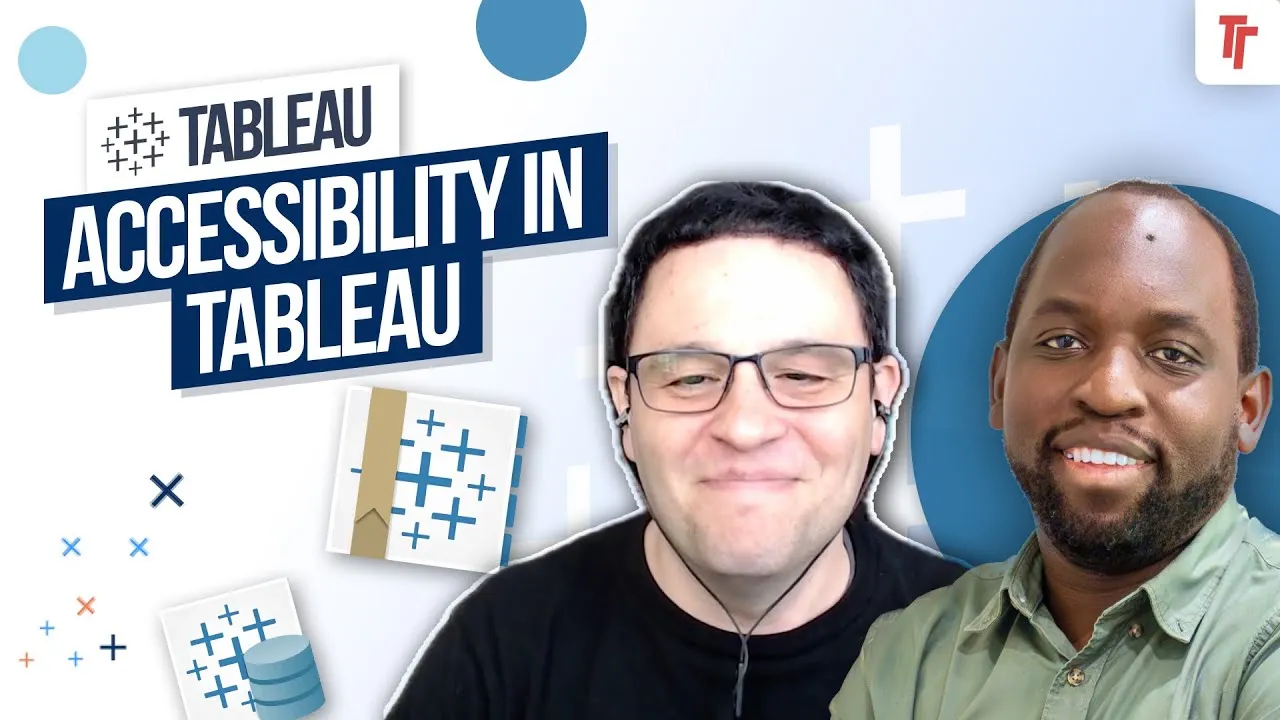
 Tableau | Data visualisation | Analytics | Career | Community
 Mastering Tableau (5th Edition) with Marleen Meier
- The 'average of averages' misconception is one of the most common stumbling blocks for Excel users moving to Tableau, and the book addresses it directly.
- Writing about Tableau Server without personal hands-on access required significant resourcefulness, highlighting how documentation gaps affect authors and learners alike.
- Business context and stakeholder understanding are essential when working with Tableau's AI features — the tool alone is not sufficient without domain knowledge.
- The fifth edition evolved from a multi-author project to Marleen becoming the sole author, giving the book a more consistent voice and updated governance coverage.
- The book is structured to take readers from beginner to advanced ('Jedi') level, with follow-along dashboards to reinforce practical learning.
0:01Hey, it's Tim.
0:02Just a brief note before the start of this video.
0:05Throughout this video, you'll see subtle hints towards the new brand that I've been working on for some time.
0:12This is a conversation I had with Marlene.
0:14about her new book.
0:15I've actually got a copy of it here, if I can lift it up.
0:19It's a chunky piece of work.
0:20It's a very detailed, thorough book.
0:24I wrote the forward for this book and I invited Marlene onto the channel to talk about it.
0:29And we're going to do something special to uh three people who watch this video and then uh fill out a quiz which you'll see linked inside of the description of this video if you're seeing this on LinkedIn.
0:41in the comments.
0:42Um I'll enter you into a drawer to win the book and I will personally write a note to the winners and then send them the copy of this book.
0:50So I've got three copies of this just to prove I've actually got them here and I'm not just making it up
0:55They're really decent chunky pieces of work.
0:58So I've got three copies of this book.
1:00Um and an interesting fact, uh the actual sort of print edition, the one that's going out to most people, doesn't have this cover.
1:07So not only will you have
1:09a rare version of this book, you'll have a rare version of this book signed by me based off the conversation that we've had today, which I think is a nice little touch.
1:17In this video I talked to Marlene about the process of writing this book
1:20And yeah, we get into a pretty nice discussion.
1:23It turns out we have a lot in common, and that's what you'll find out through most conversations with people in the tablet community.
1:28So I highly encourage that you stick around till the end.
1:31One final note, um, I'm really close to pushing the new brand out.
1:37I I decided to just stop making content, just have a break.
1:41It doesn't matter if I miss a release.
1:43It doesn't matter if if if if I'm not sort of up to date with everything.
1:46I have opinions and all of it, but I just haven't had, you know, the time.
1:49I needed to give this rebrand time and space.
1:53I realized that for some time I've just been sort of iterating some work that I did in 2019 when I started this channel and it's about time that it had some proper attention.
2:05So
2:05I started off this route of getting some help to do it and then actually I decided to go on the journey solo.
2:10And so yeah, I'll make a video about that in due course.
2:13This week I've got uh two exciting videos, this one with Marlene.
2:17and another one with Kirk about composable data sources.
2:20So look out for that.
2:21Anyway, that's enough from me.
2:23Let's get into the video.
2:24Marlene, welcome.
2:25How are you doing?
2:27Hi Tim, I'm fine.
2:29How are you?
2:29Very good, very good.
2:31Thank you.
2:32Thank you for joining me on the channel.
2:34It's uh a privilege.
2:36Um I've I've
2:38sort of come across your work in the past and then in the last uh few months you reached out to me to to support you with uh uh the book that you're writing which is obviously what we're gonna talk about and
2:49I thought, well, once the book is out, we should get you on the channel to have a conversation.
2:54So here we are.
2:56Thank you.
2:57Thanks for having me.
2:58And likewise, I have followed you for
3:01Yes, and um I cannot believe that we are here now.
3:05It's amazing, it's amazing.
3:07And and you know, I have to say I think um that you know the Tableau community is sometimes this thing that like feels big and massive and actually
3:15people sometimes feel like reaching out to certain people is sort of unattainable.
3:20But I I think you just you just literally dropped me a message, right?
3:23And we were just like, hey, would you like to do this?
3:25And I was like, sure, why not?
3:27What's the I Yeah, I I didn't know if if you would say yes, but I thought it's worth a try.
3:36And I was so happy when you said yes.
3:38So thank
3:38Thanks again.
3:39Yeah, yeah, absolutely no.
3:41Honestly, I I think that's an important thing to to highlight because um I I did sense
3:46I did sense in your request that you weren't sure that I would say yes.
3:52Yeah.
3:53No, I really wasn't because yeah, I mean it's
3:57It's a privilege to have you as the writer of the forward.
4:02But I am also sure that you are super busy and I don't know how many of these kinds of requests you are getting.
4:08So I was like, okay
4:09Fingers crossed and then it worked out.
4:11This was really cool.
4:12Yeah.
4:12Amazing, amazing.
4:13You were persistent as well.
4:14I know I I missed my own deadline a couple of times.
4:17Um and then I think I went quiet and
4:20Um I I think it took like four escalations to actually get me to send it in.
4:24So sorry for dragging you through the dirt on that one.
4:28That's that's just my own uh tidiness and um you know inability to keep to my own deadlines.
4:33But
4:33I'm really grateful we're here.
4:35We have the book.
4:37I have the book here.
4:38I think you have the book as well.
4:39So really excited to talk about it.
4:41Um uh although this won't be the final cover.
4:44We we've talked a little bit about this.
4:46We can get into that in the process, but um yeah, no.
4:49Um
4:49I think the best place to start would be to start with who are you?
4:53Like what do you do for a living?
4:55Let's put the book to one side.
4:56Just tell us about yourself.
4:58Yes.
4:59Yeah.
4:59So um
5:01Yeah, I'm uh I'm Marlene.
5:03You introduced me already.
5:05Um uh work-wise, I'm the data governance lead at a re-insurance firm in Switzerland.
5:13Okay
5:14I just moved to this role last September.
5:18Before that I was 11 years with a Dutch bank and moved with them all over the world.
5:25Um so yeah, uh other than that, um I'm a mom of a two-year-old.
5:31So that's that's super cool.
5:33A very new experience.
5:36Um yeah, and I I like analytics, I like working with data, and um other than that, I like doing sports as well.
5:46Good.
5:46What's sports by out of interest?
5:49Uh so I did gymnastic for the longest time, but now I feel like I'm way too old.
5:54So I started playing tennis.
5:56I'm really bad.
5:57But it's a nice board to do, I think.
5:59Um and swimming as well.
6:02Amazing, amazing, amazing.
6:03We have a lot in common, you wouldn't believe.
6:05So I have uh uh a daughter who's nearly two, but I also have
6:09I have three kids under five years old, so I had them quite close together.
6:13So that that feeling of a two-year-old, like I've lived it three times, it's it's just like crazy.
6:20So
6:21Yeah, you expect that.
6:22But it's also the best.
6:23It is, it is.
6:24Both at the same time.
6:26It is.
6:26Absolutely.
6:27And then um professionally, uh insurance is one of been has been one of the sectors that I've I've I've worked a ton in.
6:33So
6:34um whether it's uh with Tableau, actually predominantly with Altrix, I've tended to work on um insurance uh processes, if that makes sense, and helping businesses um stand them up uh through data pipelines.
6:47So insurance
6:48uh specifically actually healthcare insurance um and then i'll say insurance governance but for like a large um let's say
6:57insurance firm who also does reinsurance.
6:59So we could nerd out about insurance for a long time.
7:02It's definitely one of those um sectors that I find fascinating.
7:06So yeah, very, very, very exciting to have the overlap there professionally as well.
7:10It's uh it's super super cool.
7:12Are you new to insurance or is this is this has this been an industry that you've been in for a while?
7:17Um no, so fairly new.
7:20Um so until last uh summer
7:26I worked with this Dutch bank, but it was actually a clearing bank, so all of our customers were trading firms.
7:32Yes.
7:32Um, and it was quite niche.
7:34And I feel the same about reinsurance.
7:37Okay.
7:37Um, it is a bit niche.
7:39I mean insurances are all over the place, but I think reinsurances are smaller.
7:44Yeah.
7:45Smaller.
7:45Yeah.
7:46And um so I think that's where the overlap is.
7:49Um but I also like that it's now a bit of a less regulated environment, still highly regulated compared to others.
7:57Yes.
7:58Um but it gives me a bit more freedom to explore
8:03What is possible with, for example, new technologies, AI, etc.
8:07?
8:07Yes.
8:08Um, yeah.
8:09Yeah, no, it's it's fascinating.
8:11And so
8:11We're we're we're here nerding out about reinsurance.
8:14It probably would help if I try and explain it, but you can hold me accountable to see if my explanation's good, right?
8:20So my understanding of reinsurance is essentially uh companies, very large insurance companies, will insure customers um for certain products.
8:31But then what they'll do is they'll run some calculations and they'll realize that they are carrying too much of one type of risk.
8:38So what they then do is they
8:40Uh my assumption is they collect that risk into like uh like a package and then they go out to the market and ask someone else if they would ensure
8:49that bucket of risk, if that makes sense.
8:52So then uh another company then insures that bucket of risk.
8:56So it's reinsurance because
8:58an insurance company is literally reinsuring someone's like a risk, but it's a different type of risk.
9:04They sort of structure it differently to spread the risk around.
9:07That's sort of my layman's term.
9:08Is that is that a fair assumption?
9:10Yeah.
9:11Absolutely correct.
9:12Yes.
9:12And maybe interesting to know in terms of data.
9:17We then would not know about the actual insured
9:21person.
9:22So let's say you have a car insurance, we would not know that it's your insurance.
9:27We only know the insurance firm you are with.
9:31And then we just get this package.
9:33See, so I'm like anonymous to you, but you know that you're ensuring a certain type of profile and you know whatever.
9:42That's interesting.
9:43Yeah.
9:43That's that's super cool.
9:44And and I find that really bizarre because that that suggests that it's possible to reinsurance reinsurance because reinsurance
9:53companies themselves also do the exact same thing.
9:56So yeah, we actually do that as well, yes.
10:01So it's just it's just basically spreading risk.
10:03That's the simplest way to think of it.
10:05And that's uh and it makes t it makes sense, especially when companies have
10:09specialisms, they can carry too much of one type of insurance because that's what the insurance they're known for.
10:15So they'll go to the market to an insurance company that, you know, has a different, let's say, profile, wants to get, you know, a bit more revenue, a bit more income, um, and that will
10:23That'll be how that works.
10:25So yeah, amazing.
10:26I love this because yeah, like data is data, but like we we don't often talk about the professions themselves.
10:32And I think it was good to nerd out on that a little bit.
10:35Um
10:36Let me step back a bit then because obviously you've written a book about Tableau, but then the gap between like what you do today and the book is well how did you even start with Tableau?
10:45What made you like pick up Tableau for the first time?
10:49Yeah.
10:50Um so while I was working in this Dutch Bank, so I was a quantitative analyst there in the risk modeling team.
10:58And we were basically responsible for the prototyping of the risk model.
11:04And m for me specifically, it was really the data input and the output.
11:08So I was always checking
11:10Do we have um data good enough to go into the model?
11:14And what does the output look like?
11:17So then I thought, I cannot do this all in Excel.
11:21There must be a software
11:23And at the same time there was a project ongoing where they were piloting uh Tableau um in our firm
11:31So I became part of the pilot and then um I loved it from day one.
11:36It just made so much sense to me.
11:39Um I feel that the Tableau interface is very intuitive.
11:44Yeah.
11:46And I taught many people, but I think not everyone feels the same about it.
11:52But
11:53Uh for me it's definitely very intuitive.
11:56It's like the person who designed it had a similar brain uh than me or something.
12:00Exactly.
12:00Yeah, yeah, yeah.
12:01Yeah.
12:02Amazing.
12:02Uh yeah, so that's how I started using Tableau and then it made it all easier to just visualize
12:08big amounts of data and um how good the data is, where it is, uh, what the stakeholders needed to know.
12:17Yeah.
12:19Yeah, so that was the start of my Tableau journey.
12:22Amazing.
12:23Um and then I went to the Tableau Conference in London.
12:29Yes.
12:31And I was blown away after I think it was maybe two days at the time.
12:38And um I learned so much.
12:41It was unbelievable.
12:42And it was just the start of my Tableau journey.
12:45And I came back
12:46And I thought I could not have learned all of this in like half a year time.
12:49Wow.
12:50The sessions, everything.
12:51It was amazing.
12:52Amazing.
12:54Uh yes.
12:56And then I thought, all the speakers here at this conference, I want to be one of them at some point.
13:03Yes.
13:04I also want to share what we are doing.
13:07So I applied for being a speaker at a Tableau Conference in London the next year.
13:11Okay.
13:12I got a spot.
13:14So I presented a machine learning data visualization project.
13:18Yeah.
13:19And then Peck reached out and then they said on LinkedIn, are you interested in uh writing a book?
13:26Um
13:27They already had the first version of Mastering Tableau.
13:30Yeah.
13:31But it was outdated.
13:32Yeah.
13:32And then they needed someone to write the next edition.
13:36Yeah.
13:36Yeah.
13:37Yeah.
13:37Because the initial author didn't have time anymore.
13:40Yeah
13:41And I thought it was a scam.
13:43I don't know this this can't be true.
13:49Yeah.
13:50Um
13:53But yeah, no, then I I started talking to them to just figure out is this really are they serious?
13:59Yeah.
14:00Yeah, so this was my my journey and then the first book came out in 2019.
14:05Yeah.
14:06And do you remember the c the year of the conference?
14:08I want to see if we were maybe both there and didn't know each other at the time.
14:12Oh, I'm pretty sure it was 2018.
14:152018, yeah.
14:16We would have both been there.
14:17Because 2018, um that was I think yeah
14:25Would it have been?
14:26I'm trying to remember the venue.
14:29So that year was in X Excel, but the year before my first Tableau conference was in this tobacco tobacco dock.
14:37Yeah.
14:38Yes, yes.
14:39So I wasn't at Tobacco Dock, but I was at the Excel Center.
14:43And I think at the Excel Center
14:46Um I was obviously there with the information lab.
14:48You might have you might have seen me had a stand or something there.
14:51But yeah, no, very small world.
14:53Very small world.
14:53That's amazing.
14:54I know exactly like I remember that conference.
14:56Very sunny day.
14:58Uh a really long time ago now.
14:59Yeah.
15:00Yeah, you're right.
15:02Sunny everyone was sitting outside.
15:04Yeah, exactly.
15:05Exactly.
15:05Yeah.
15:06I always have these um
15:08uh you know moments how you meet people uh in life or you don't meet them but you cross paths not knowing each other
15:16And many, many years later, you actually directly cross paths, but you didn't realise that was gonna happen at the time.
15:22And this is one of those.
15:24Both at the same conference.
15:25twice and then here we are um doing the session.
15:28So cool.
15:29You said two things I also wanted to pull a thread on.
15:32The first one was um you were teaching Tableau.
15:34So
15:35You you picked up Tableau, you learned it.
15:38Um the thing you said about the interface, absolutely spot on.
15:41I still agree with this as well.
15:43I think a lot of people think I'm like, you know.
15:45coming off Tableau.
15:46I actually still agree that the interface to me works the way I work.
15:50It's very easy to to drag things around and work with it.
15:53Um
15:54When you started teaching it, what was the biggest thing that you saw people had a challenge with, if that makes sense?
16:02Um
16:04Moving from Excel to Tableau.
16:06So I think most of the time they were trying to do something that they always did in Excel.
16:12Yeah.
16:12And then they were
16:15But so I think they just try to copy and paste instead of learning a new way of thought process.
16:25Um yeah, and then s the other thing but minor not knowing
16:34what effect their action has on the underlying data and then being surprised that they don't see the expected result.
16:43Like for example
16:44Average of averages.
16:47So that they were then complaining, oh no, but if I if I take the average of all of these numbers, it's not the same as the average
16:55Yes.
16:55Overall.
16:56Yes.
16:56Yeah, it's not but that is on purpose.
16:59So things like that.
17:00Exactly.
17:00Exactly.
17:01To pick up on that.
17:02Gosh, the average of averages.
17:03This uh this this really hits at
17:08I think it's still the hardest thing to understand about Tableau today.
17:12And it's why Excel, I always think of Excel as like the arch nemesis.
17:19Excel breaks this problem down because of this simple concept of uh cells and then being able to reference cells or reference tables.
17:29So you can do a V lookup across two tables
17:32Now a VLOOKUP allows you to skip this problem of contextualizing your totals.
17:39You see in Excel you'd
17:41average a list and then you go to another tab and if you're not careful it Excel doesn't stop you taking that average and adding them up with a bunch of other averages.
17:52And you don't think of it.
17:53You don't understand like why is that, right?
17:55And then it's not until level of detail calculations came along where I was like, wait a minute, I've been doing this wrong.
18:02Like I've not been I've not been thinking about this.
18:05And
18:06The reason I had to understand this for the first time was the exclude function and the include function, which is they force you to have to know what's going on like underneath the covers.
18:16Yeah.
18:17And at this point I I I sort of felt like I philosophically understood Tableau better because of these two features.
18:25And I think it's it's something you hit on here, which is
18:28the analytics products we use today, the ones that work really well with us, you have to understand them at a philosophical what level.
18:35You can't just sort of, you know, grab a tool and uh just start, yeah, this is how it works in Excel, so I'll copy that.
18:42philosophy over to Tableau, you can't copy the philosophy over.
18:45You can copy over the calculations.
18:47You can copy over the um you know the way you approach the problem.
18:51But the philosophies are fundamentally different.
18:53And I think that's something, again, we'll get into this.
18:55Your book really tries to step people through.
18:59It's like
18:59Here are the basics, here are the foundations.
19:01These are the things you need to understand really, really well.
19:04And then you piece them together to better have a philosophical understanding of the product.
19:09Which then makes your life easier to do more and more complex and challenging things down the road.
19:15Exactly.
19:15Yeah.
19:16Yeah.
19:16Yeah.
19:16Yeah.
19:17Awesome.
19:18Right.
19:19So um
19:21Right, you've gone to conference, you you've done a talk on by the way, first talk, machine learning.
19:26That's a very complicated talk
19:29Yes.
19:31So maybe I can I can elaborate a little bit.
19:34Yes, yeah, go for it.
19:35I was gonna ask, yeah.
19:37So I had a colleague uh machine learning um specialist.
19:42Yes.
19:43And uh so like I said, our clients were trading firms.
19:46Yeah.
19:47So what we tried to do was we wanted to see trade anomalies.
19:52Because we know that most companies use algorithms, so we try to identify a rogue algorithm before they would incur a huge loss.
20:02Yes.
20:03Um so harder said than done.
20:06But when we had some output, we gave it to the risk managers.
20:11And then they said, okay, nice that you give me now a list of these anomalies.
20:16But how did you come up with this?
20:19So what we tried to do in this Tableau dashboard was to show how this anomaly behaves compared to the peers.
20:26I see.
20:27So that they can maybe see
20:30Why the model so kind of yeah taking it out of the black box
20:37and doing something so that they would understand why the model would come up with this.
20:42Yeah.
20:42And then trust the output.
20:44Yeah.
20:45So that was the purpose of the dashboard.
20:47It's now literally using visual analytics, right?
20:50It's it's it's making it you know, here's a number, it's it's not working.
20:54Why?
20:55Well you have to look at the data and how it behaves compared to its peers and
20:59I guess that's complex because some of the variables you might be looking at might not be sort of linear per se.
21:06It might it might not be as simple as just, oh, this is higher and this is not this these are its pairs are lower
21:12it's probably more statistically grounded than that.
21:15And so Tableau is a really good way of aggregating that and um yeah making it making it sort of talk a bit more.
21:21Okay.
21:22Um and so
21:23Your y the book, you mentioned that you picked it up from um a previous author.
21:30Was that the fourth edition, I think, if I if I'm doing the maths correctly?
21:34Um and and you've
21:35Rewritten this for the fifth edition or was the fifth edition the first one that you're picking up?
21:40So I picked up the second edition.
21:42Second edition, wow
21:43Okay, I'll go Yes.
21:45You've been at this a while.
21:46Amazing.
21:47Yes.
21:48Yeah.
21:49So second, third, fourth, and now it's the fifth.
21:52Unbelievable.
21:53Amazing.
21:53Oh man, we got so much to talk about.
21:55So you've been you've been at you've been at this game for a long time.
21:58You've basically written one.
22:00If I try and do the maths, that's like one every other year, is that right?
22:04So Yeah.
22:04Because it takes yeah, it t it doesn't like
22:06I'm sure you'll tell me this.
22:07Like writing a book is not a year-long endeavor.
22:10It's it's a lot longer than that, right?
22:12End to end.
22:13Yeah, it's yeah, it is a lot of work.
22:16Amazing.
22:17Yeah.
22:18Okay, so let's get into it.
22:20Um, mastering tableau.
22:22Um, when you did the second edition
22:25I guess the version of Tableau back then was 20 well if if they approached you in 2018, you would have
22:34Come out in 2019 or 2020?
22:36Yeah.
22:37Yeah, 2019.
22:38Yeah.
22:39I think uh I don't remember if the book specified I think
22:452019.
22:461.
22:46So now you don't see that anymore.
22:48Yeah, it just specifies that yeah.
22:49Good move.
22:50Yeah.
22:50Yeah.
22:50Yeah.
22:51Yeah.
22:51Yeah.
22:52Back then it made sense because I guess the product wasn't
22:56Um it actually did make sense because the version number kind of let you know that the book could take you up to a specific point.
23:02But then also um
23:04in subsequent editions you wanted to communicate that it was an up-to-date book.
23:08So the version number was a logical thing to do.
23:10Um but I think you've also made the right decision to not do version numbers going forward, just to have the year as the grounding point because
23:19I don't know about you, but as a content creator, I see a lot of the topics that we cover, a lot of the principles don't change, right?
23:28Like in the product, right?
23:30Um and so the things you do focus on more in this book actually are the things that are, let's say, um more abstract, the things that you can spend more time on once you've got the the the basics down.
23:42So
23:42Um maybe talk to me a little bit about, you know, how you approach each edition.
23:47So you've gone second to third to fourth to fifth now.
23:50Um I think in past editions you've not been the sole author, but in this one you are.
23:55Is that is that a fair thing to say?
23:56Yeah.
23:57So yeah, maybe talk us through that journey a little bit and um yeah, how's it been?
24:01Yeah
24:02Um so since the first version was of course all written by somebody else, um he is still mentioned on the second and the
24:12third edition as well because there was still a lot of content that he had written.
24:17Right.
24:18Um by the fourth edition I had changed so much that um
24:24Did did they offered me to take off his name?
24:27Yeah, yeah.
24:28Um, yeah, so this is why now it's solely me.
24:32Yeah.
24:33Um yeah, and yeah, so the second edition was I think very the process was new.
24:41uh working with a publishing house was new writing so much and being very precise and really trying to
24:50give something to people that they can use, it was very hard.
24:54Um I also feel it was a lot of updates on the the interface, the
25:02Um I think um I think yeah LODs were new Yes, yeah.
25:11Sorry.
25:15Go for it, go for it for it for it.
25:16Have a break.
25:23Um yes, so that was the second edition.
25:27And then in the th and and it was still a lot with um so all the examples in the book were with the
25:34Sample store dataset.
25:36Yeah.
25:36So then in the third edition, I try to get rid of that and put in other data sets.
25:43So that the users can also do something different than what you find everywhere, y you know?
25:49Yeah.
25:50Um so that was the I think the biggest step from two to three.
25:56And then from three to four, I try to make it a bit more interesting, adding Python and real use cases, not just okay, this is how you connect to Python and then figure the rest out yourself.
26:09Yeah
26:10Um so the advanced analytics part was then.
26:16And yeah, now with this one, it is a bit more towards governance.
26:21I see.
26:22Also all the the the content is of course still there about LODs, table calculations.
26:28All of that is there for sure, but there's a chapter dedicated to data governance.
26:33That's really good actually.
26:34And um you sent me through um when I agreed to do the um forward you sent me through the chapters um to look through and I I felt like you um
26:45You did um this is a compliment.
26:47You did like a a very um healthy job of being honest about the fact that
26:55Tableau wasn't just about, you know, drag and drop.
26:58It it wasn't just about knowing how to do stuff and you know ticking your certifications.
27:04It was also about this, let's say, discipline and uh practice and
27:09you don't intuitively sort of pick this up and and this is the bit that a lot of people miss.
27:14Yes, they know how to use the product, but they then don't set themselves up for success in an organizational setting, right?
27:20They don't set themselves uh well up for
27:23other people coming in to use their content.
27:25And so when you actually start to think about that, you come across this, let's say, um
27:32difficult decision where you have to decide even though Tableau can do this, maybe we shouldn't do that, right?
27:38And in other places
27:40You know, maybe, you know, even though Tableau can do this thing, I need to take my users on this journey of maturity to educate them on the capability before I then just throw it in their face.
27:52So yes
27:5320 whatever might be new, but let's let's spend six months educating our users on on this path.
27:59And I feel like your book, like, just by looking at the chapters, like did that justice, which which I thought was pretty important.
28:06Thank you.
28:08Thanks.
28:08No, it was really good.
28:10Um, and then I guess one other thing, which is um okay, the process of writing it.
28:16So
28:17I I don't know.
28:18Tell me if tell me if I'm wrong here, but like it sounds like the process of writing the book has been iterative in the sense that you've had multiple editions.
28:27So this isn't sort of um
28:30you know, sort of uh like your first rodeo, if that makes sense.
28:34Like when you when you write a book for the first time, and I've talked to other authors before, when you write a book for the first time and you start from zero
28:41There is sometimes the things that are left like that you wish you had time to go back to.
28:48Oh yes.
28:49Oh.
28:51Right.
28:52And I've I've I've
28:54I'm, I don't know, shoot me down if I'm wrong here, but I get the sense that like this fifth edition is also an opportunity for you to kind of look back and really kind of take what you've learned of past editions and
29:05like give this sort of, you know, the Marlene seal of approval, you know, for the next few years, right?
29:12Yeah, that's very true.
29:13Um
29:14There was quite some feedback on more use cases.
29:18Yeah.
29:18So when, for example, there's a chapter on uh level of detail calculations.
29:24Then while explaining the concept, I would uh give a step-by-step exercise that the reader can follow.
29:34There was a lot of feedback that the readers wanted more, not just this one example.
29:38Yeah.
29:39So now I think uh one of the other things that is quite new is that on
29:44Almost all chapters, there's a specific follow-along dashboard section at the end so that um the users can practice one more time, at least one more time.
29:55Yeah.
29:55Yeah.
29:55I absolutely it's and I'll and honestly, I when when um I saw the thing, I was like, oh god, you you can't keep this up all back, right?
30:04And like you can't keep then.
30:06This is a lot this is a lot of work.
30:08And I say this as someone who's built
30:10um courses, I've been a certified trainer, I've I've taught a lot.
30:15And one thing I've always appreciated is when I don't design
30:19The learning package, I'm so happy because I look at the case studies and I'm like, oh God, thank God someone else did that for me.
30:27Yeah.
30:29It's not, I have to say, it's not like
30:32Super super advanced uh follow along because that would just then the book would be, I don't know, three thousand pages long.
30:39Exactly, yeah, yeah.
30:41So it is
30:42quite concise in the sense of Yeah.
30:45Yeah, this is what we did this chapter.
30:47And then the dashboard won't be the most fanciest dashboard you have seen, but at least you can practice the concept.
30:52Exactly.
30:53I I faced this actually when I was doing
30:56um a course with LinkedIn which is man if I show you like the best dashboard this course will be like double the length
31:04But I have to just be humble and say, no, we're learning skills here and if you can build this exact thing, I know you understand the skill.
31:11And that's really, really well set out in the book.
31:14Um and it honestly it's why
31:16It's one of the things like um uh I talk about in the Ford, which is you you show um and then you you always have some sort of use case applied approach.
31:28But then you're also tying it in with the soft skills and the governance and and and everything else.
31:32You've kind of done a really delicate job of weaving this.
31:35And
31:36Most books will never get this level of, let's say, depth because they wouldn't have had five editions to really master this sort of balance and gather the feedback.
31:45And so you've you've
31:46You've put together, I think, the book that most people would have wanted at the start of their tableau career, like when we started or, you know, way way back when.
31:55Uh but that's what's in here now.
31:57And for everyone learning Tableau or relearning it, 'cause I you know, it's very easy to sit here and and think you know it all, but even flicking through the things, I was I I flicked through some chapters, I was like
32:08Actually, I I'm I'm not sure I could teach that.
32:11I have no clue.
32:12I have no clue on the depth of that.
32:13I know the concept.
32:14I know how it works in like practice, but
32:18You revisit things and you realize, oh, I haven't actually done it that specific way for that use case.
32:23And use cases are where that really comes to life.
32:25So really, really, really good work on that.
32:28Thank you so much.
32:30I I do have to say that um there was a moment in my Tableau journey where I thought, I don't know if I'm a beginner or advanced or somewhere in between, because I don't know what I don't know.
32:43Yes.
32:44So now I feel of course very confident about all the features, but I hope that with a book
32:51People will know, okay, this is the full scope.
32:53I know half of it, so there's another half that I might learn or not because I might not have a use case for this.
33:01Yeah.
33:02Um one of the I'm gonna link this to Tableau Conferences.
33:06One of the things I hate most about Tableau Conference
33:09is when people have to classify themselves on like whether they're beginner, intermediate, or Jedi.
33:16And I'm I'm really always curious.
33:19who selects Jedi because I'm just like, listen, I'm Tableau Tim here, and people would think I'm a Jedi and I don't think I'm a Jedi.
33:28So let's just get this straight.
33:30Like, why do you think you're a Jedi?
33:33And I I love having these conversations.
33:36You should go to all sessions.
33:37All sessions are fantastic.
33:38But I always think like
33:41You you don't know what you don't know.
33:43And to me, a true Tableau Master knows this exact point you just said, which is you you appreciate there are many parts of the products you will never have a reason to touch, and therefore
33:54you know you don't know them and I think yeah it's important to be humble in that respect.
33:58Absolutely.
33:58Absolutely.
33:59Yeah.
33:59Yeah.
34:00Um another go for it.
34:02No, go for it.
34:03No, you go.
34:03Another thing I just wanted to say is also compliments to you for writing the forward.
34:09So when I read it, it was at the very end of this
34:13the process and um I also reached out to you maybe a little bit too late because we were so close to publishing it already.
34:20I was really demotivated and then I read it and it gave me so much
34:24energy to just f finish finish strong hopefully.
34:30Yeah, so thank you for that.
34:32Oh I didn't say that.
34:33I think everything you said resonates so well with the current situation and so many moving pieces in the in the space.
34:44Yeah, absolutely, absolutely.
34:45And you know, for um, I guess for the people's uh benefit, I should uh you should just get the book by the way, if you want to read the forward in full.
34:53But what I will do is maybe just touch on like the key thing I I sort of opened the forward with, which is look, we're all talking about AI.
35:01Why would you even want to, you know, learn to use Tableau?
35:05And I think I've touched on it it already in this um
35:08conversation and it it goes back to this principle just knowing how to do something isn't enough.
35:14You have to be um you have to have like um
35:20If I step back, sometimes I say to Tableau directly that I feel like their product managers don't have intuition of how the product should work.
35:31And that intuition comes from a place of using the product long enough to have had paper cuts in your hands, you know, the painful scars you get from
35:42being a carpenter, being a plumber, um, you know, everyone has them.
35:46Like if you do any trade, that trade leaves its its its its its imprint on you.
35:51And that imprint
35:52gives you this intuition of how to approach problems, how to do things quickly, how to do things eff efficiently.
35:58And it's hard to pick that intuition up.
36:02Now, if you start using AI with that without that intuition, what's going to happen is you'll you'll build things that you think are successful.
36:10But they'll fall over at the simplest of hurdles because they've not had the depth and thought put into them that you get with intuition, you get with working through things.
36:20And so um
36:22I don't expect everyone to sit, you know, and go through your book cover to cover.
36:26That's not that's not how real life works, right?
36:29But I do think as you're like going through a learning journey, the reason I really sort of
36:35found excitement in this book is that, hey, if you are sitting there learning Tableau today and you're thinking, oh, I'm I'm gonna be using Claw to drive these things, well yes, but you're still gonna have to know when to ask for certain capabilities, how to ask for those things.
36:49And you're also going to need to know when the approach it takes is wrong.
36:53These tools can build things, they can drive things, they can pull data, they can bring an incredible amount of power to you, but it's all wasted if you don't
37:01channel it in the right way.
37:03And so that's where I think this book becomes super important because I think yeah it gives you the foundation to that.
37:08And if you're doing that with AI and you're you've got the book with you, like I think I think that's it.
37:13That's you you're in a really, really good place
37:15To have the understanding but then also the practical sort of implementations as well.
37:19Yeah.
37:20Yeah.
37:21Called nooguri more.
37:22Yeah.
37:23Good.
37:23Um what's your favorite chapter, if I may ask that?
37:27I know you can't have favorites.
37:28You're gonna say all the chapters.
37:30But like which which chapter uh like are you sort of happiest with or is there is there like a a message or something behind one of the chapters that sort of makes you want, you know, to recommend that chapter more than others?
37:42If that makes sense.
37:44Um not sh depends on the person reading.
37:48Uh but me personally, I really like the advanced analytics chapter, uh the one with uh Python, because
37:57it it was a challenge for me as well.
38:02Like more so than the other chapters.
38:04Yeah.
38:05So that's why I I really like that one.
38:07And in my in my day-to-day work
38:10I didn't use Tableau in that way that much.
38:13I see.
38:14But I did use it a lot for the other stuff.
38:17Yeah.
38:17Um, so this is a bit new, so it's
38:21It's exciting, so that it's uh Yeah, yeah.
38:24It's it's interesting and I think um I can I can share this sort of emotion too.
38:29Sometimes when you have the role of educating people
38:33uh peop people maybe get the impression that um because you're teaching it you do all of it all the time, right?
38:42Like you you
38:43Marlene is teaching this incredible depth of knowledge.
38:47That means she's literally in every interface of Tableau, every minute of the day.
38:51Um and that's obviously not true, right?
38:53And it's no we spend more time in other areas.
38:56And so what happens, and this is something I'll admit happily, is that when I make a video about something, sometimes
39:03I don't know that feature that well.
39:05So I learn it before teaching it.
39:07And it's it's sort of counterintuitive, but teaching is one of the best ways to learn because you have to
39:13Teach it to a standard where you know that you're going to answer all the questions that someone might have if that makes sense.
39:19So it's super, super important.
39:22And yeah, I love it.
39:23And, you know, with the Python, I guess it's interesting because that's a bit that AI can do really, really well, right?
39:29So it's yeah, it's it's it's a very interesting chapter to push because you would hope that someone would look at that chapter
39:36And look at the stuff that Claude can do and hopefully be able to build really powerful things with the guidance that you're giving them, right?
39:42Uh and the way you're kind of bringing that bringing that together.
39:46I'm really curious.
39:49what what will be out there in in the next couple of months.
39:53If people will use it that way.
39:54Yeah.
39:55Yeah, I I want to see it.
39:56Yeah.
39:57Yeah.
39:58Amazing.
39:59Okay.
39:59And then uh one more question.
40:02Which of these chapters do you never want to see again?
40:07Oh.
40:08I'm sure in the writing process there's a chapter that just like, you know, comes back to haunt you.
40:12So is there one that you think, ah, you know, this was a tough one?
40:16Yeah but yeah I I will explain but it's the Tableau server one I would say.
40:23Right
40:23Um and why?
40:25Because I don't personally have a Tableau server.
40:29Yes.
40:29So it is just yeah, it is just so much harder to produce good content.
40:35on something that you only access in that extent at work.
40:40Yeah.
40:40And not at home.
40:41So that's why
40:43Yeah.
40:43Yeah, yeah.
40:45I I um I made the mistake and I call it a mistake because I gave people the impression that I could do this.
40:52I made a video about Tableau Server installs and I I can do Tableau Server installs.
40:58I was certified Tableau Server Admin by Tableau and Trainer as well at one point.
41:04So I can do that stuff.
41:05So I made one video about it because I just thought I get endless questions about this.
41:09So I just made one video.
41:11And immediately everyone was like, oh great.
41:14Tim, Tim knows server stuff.
41:16Can you do a video about this?
41:18Can you do a video about that?
41:19And I was like, Oh no.
41:20No, no, no, no, no, no, no.
41:22Calm down everyone.
41:23Like, no, I I can't I can't
41:26I c I can't do like a multi-cluster server install because I like where am I gonna get like four servers to like, you know, I don't have an AWS like credit card or somewhere that that that I could justify.
41:39And so
41:40For a brief moment I went down this thing maybe I should try and do like a sponsored series, get someone to sponsor like some AWS credits, we get all the questions and then we do like a live stream for 24 hours.
41:50on someone's credit card, they pay for it, and then we we get all these questions done.
41:55And that was gonna happen.
41:57And then I realized, oh my God, like
42:00When I went to try and do a practice of this with my own like credit card, it just failed every single time.
42:07Like I was coming across bugs.
42:09And then it would take me like two, three days to go troubleshoot them.
42:12Yeah.
42:12I was like, this would make such horrible content.
42:15Like this, no, I'm not gonna do this.
42:17So I just I just didn't carry on.
42:19But it is very complex.
42:21Um not only that, you can't necessarily, you know, go to your work and go, hey, sirman, I'm writing a book.
42:28Do you mind just giving me
42:29admin access to the whole entire company's server.
42:33It's not gonna happen.
42:34And taking screenshots and then sending them somehow to my own personal example.
42:38Yeah, exactly
42:39Yeah.
42:40We're talking about governance, isn't it?
42:42It's not exactly the best it's not the best images to be to to be to be setting up um uh your employer.
42:48So now uh yeah to to everyone watching
42:50Sever is difficult.
42:52But I will say that like 80% of the capability is covered in cloud in most ways.
43:00The other 20% is not, but then
43:03You wouldn't want to follow a tutorial on the internet about that 20% because that 20% is going to be configured very specifically for that organization.
43:12So
43:13The way I justified in my mind is I'll just keep covering Tableau Cloud and I'll just let server be and you know, people will
43:20People will find the help they need, if that makes sense, but eventually everything makes it over to to Severin and it's not a problem at all.
43:27So yeah.
43:30Now, although I um you know opened the chapter saying, hey, you know, what are we going to do with AI?
43:36Um you do have a chapter about AI in in the products.
43:39And so
43:40I think what I'd be curious to sort of understand from you is um, you know, this technology is moving very, very fast.
43:49What would you say are the most important aspects that people should be taking into their AI workflows, if that makes sense?
43:56So yes, we've got tools that are amazing.
43:59Yes, we've got AI inside of things like Tableau Pulse and Tableau Next.
44:03But what would you say are the things that people themselves should be bringing to those products sort of separate from the AI capabilities?
44:13Separate from the So you know if I explain that a little bit more, you have uh Tableau Next, Tableau Pulse, these are all great uh tools.
44:23They have AI embedded in them.
44:25What skill sets do people need to bring uh themselves to these new AI capabilities in the products to be able to use them well, if that makes sense?
44:34Yeah.
44:34Yeah.
44:35Yeah, thanks.
44:36Sorry.
44:37No, no, I I explained it really badly.
44:39I I went round the circle, so don't worry.
44:43Um
44:45Yeah, so I think you really need to understand what your stakeholder wants.
44:52Yeah.
44:53Doesn't matter if you use the AI products or not.
44:57I think that's just the the the basics.
45:00And it becomes even more important.
45:02by using AI.
45:04And if you if you don't know why someone wants something, if you didn't try to understand that, I'm sure that your output will not be
45:14what is expected from you.
45:16So I think in order to do to do that, you have to ask questions.
45:20Yeah.
45:21But you also need some degree of business knowledge.
45:26I mean, of course, you will not be the financial expert because you're not in finance.
45:31You're probably in the data team or somewhere.
45:34But you should still understand what is keeping them up at night and how can you help them.
45:40And I think if you can then use the AI features, or even better, explain, for example, agents in a way to your business that they can leverage whatever you have prepared for your dashboard.
45:54and do for example um uh natural language processing, I think then you will be the star.
46:02Um but you y in order to sell it, you first have to understand it all yourself.
46:07Yeah.
46:07You have to have the um
46:10What's the word?
46:11Oh, intuition is not a bad word.
46:12I've used that already, but I you have to feel the the pain of the users, right?
46:16You can't just bring AI for the sake of it.
46:18You have to know look, what are you trying to solve?
46:20why you're trying to solve it and really make sure the two connect between um the dots, right?
46:25So yeah, makes makes a lot of sense.
46:28Good.
46:29Um
46:30I think I've asked pretty much everything I would want to ask.
46:34We're going to do something pretty exciting with this.
46:36So we're going to give away three copies of the book.
46:40I'll hold it up again.
46:41to the camera.
46:42So um I have one here.
46:44I also have three.
46:45And these are the we'll call these the limited edition because as you told me at the beginning of the call, the covers are going to change on the ones that actually go out.
46:54So
46:54These three are like super rare editions, right?
46:59And you'll have proof that they're rare because the covers will be slightly different.
47:03in the ones that go out.
47:04But we're gonna send uh three of these copies to whoever's watching this uh around the world, I will personally send them out with a note in the book.
47:13Um so uh they'll come from me.
47:15But the way I'll probably do this is I'll put out a little quiz and I'll I'll have like a little form for people to fill in.
47:21And I'll ask three questions about something we've spoken about in this interview.
47:25So um it'll either be about your work, something we've talked about.
47:29I'll I'll keep it sort of
47:31Fun and um if you enter the quiz, get the questions right, I'll pull from a list of people who've got the question right
47:38um and I will personally send out the book to those people um from here in the UK.
47:43So wherever you are in the world, I'll do my best.
47:46If you are in a part of the world that for whatever reason proves difficult to send the book to,
47:50I will do my best to find an alternative way to get it to you and if we can't do that then I'll just have to apologise.
47:57I'll do my best
47:58The world is a tricky place at the moment.
48:00So I have to put that caveat.
48:02I have to put that caveat in.
48:03I can't guarantee I'll be able to send everything everywhere.
48:06But we'll do our best to get this to uh the winners that we pick out and then we'll go from there.
48:11Amazing.
48:12Super cool.
48:13Good luck, everyone.
48:15Thank you very much.
48:16Okay.
48:17Um, thank you so much, Marlene.
48:19Thanks for the conversation.
48:19It's been fantastic.
48:20Um yeah, please go out and get the book.
48:22Uh I've put
48:23I'll put links in QR codes and and everything so you can you can go and uh get the book um uh uh I think it's on Amazon, is that where p your recommended people go?
48:32Or is there a specific link that you're suggesting to people?
48:35Um yes, you can go on Amazon and you can also use for example the packed or also the O'Reilly subscription if you if you have that.
48:45The book is there.
48:46So not just on the packed, but also on O'Reilly.
48:48Oh yes, that's I forget that there's a subscription service.
48:51So I think yeah, that gives you access to the um the O'Reilly platform, but then you also get the like is it like a digital version of the book that you can access?
49:00Yeah, so then it would be an ebook.
49:02And I think even if you don't have a script subscription, you can probably on both places get the ebook.
49:07Ebook on its own.
49:08Exactly.
49:09Yeah, yeah.
49:09And actually I personally love that format.
49:11You can have it on your phone, you can you can have it on an iPad or something.
49:15Really easy to search and um yeah, and if you're easier then even better.
49:20Yeah, I I love paper books, but control F is not available.
49:25Uh no, no.
49:26And I have to say it's a it's it's a chunky book.
49:29For good reasons it's a chunky book.
49:31So
49:31Uh it's not exactly something you want to keep in your backpack uh because it is it's quite a it's like it's a ser like when I got it through, uh I I'll give you a funny story.
49:41Uh uh Shruti who we're working with.
49:44Is it Shrithi?
49:44No, sorry, I lie.
49:45What is the name of the lady that we're working with from Pact
49:49Yeah, yeah, that's uh.
49:50It is Shrithi.
49:51Okay.
49:51I have a college call Shriti as well, which is why I was like, no, I'm confusing names.
49:55Anyway, Shrithi reached out, she said, hey, I'll send you the books.
49:57So she sent them and she sent them really, really fast.
50:00So fast that when someone knocks on the door with a massive box from uh FedEx, I was like, what the hell is that?
50:07So you know how at the beginning you were like, oh, is this some sort of um scam?
50:12I genuinely opened the box being like, what on earth is this?
50:16Because it weighed so much.
50:17I was like, I can't think I can't think of what I've ordered.
50:21that would weigh this much and come in the box this big.
50:25Like I didn't order weights, I didn't order anything.
50:27And then I opened the book and I'm like, oh okay.
50:30It's four copies of this lovely book.
50:32So yeah, that's my uh a fun story.
50:36So yeah, absolutely.
50:37Uh get the book.
50:38Um
50:39I've been talking to Pact for a while as well, so um I know that they're uh pretty good at sort of working with uh with their authors and getting stuff out.
50:46So yeah, head over to Paced uh O'Reilly as well if you've got the subscription and/or Amazon to get the book
50:51And um yeah.
50:53Marlene, hopefully I'll I I know I missed you at the um you were at the Gartner event.
50:58Uh before you before we go, how did you find the Gartner event?
51:02I loved it.
51:02Yeah?
51:03It was really good
51:04Um yeah, I really enjoyed it.
51:07I think um yeah, a lot is happening.
51:11Yeah.
51:11So I'm watching.
51:12It's moving very fast.
51:13Um, I wish I could have gone because we could have connected in person.
51:17But yeah, next time you're in London in the UK, let me know we'll we'll connect.
51:20Um but otherwise.
51:21Yeah, definitely.
51:23But thank you.
51:24Thank you again for coming on the channel to chat.
51:26And um yeah, we'll see who wins the books.
51:29Yeah.
51:30Thanks for having me.
51:31No worries.
51:32Absolute pleasure.
51:33The great work.
51:34Thank you so much.
51:36All good.
51:37All good.
Link to the Quiz and Competition: https://forms.gle/nwLvnbaCcKY7AC6eA
Tim opens a conversation with Marlene about her new book, Mastering Tableau, for which he wrote the foreword, and announces a giveaway. Marleen, a data governance lead at a reinsurance firm in Switzerland and a former quantitative analyst at a Dutch clearing bank, shares how she started using Tableau during a company pilot to move beyond Excel, was inspired by the Tableau Conference London, and later became a conference speaker.
They discuss common learning challenges such as Excel-to-Tableau mindset shifts and “average of averages,” challenges in writing about Tableau Server without personal access, and the importance of stakeholder understanding and business context when using AI features.